
Beginner Dumbbell Workout: A Simple 25-Minute Full-Body Routine
Starting a strength training routine does not have to mean spending hours at the gym or learning complicated exercises. A pair of dumbbells and 25 minutes can be enough to create a simple full-body workout for beginners that trains the major muscle groups and helps build a foundation of strength. If you are new to resistance training, the goal is not to lift the heaviest weight possible. It is to learn good movement patterns, control the dumbbells, and gradually become stronger over time.
This beginner dumbbell workout combines five foundational exercises: goblet squats, dumbbell rows, Romanian deadlifts, shoulder presses, and farmer carries. Together, these movements target the legs, glutes, back, shoulders, arms, core, and grip. The routine can be performed at home or in a gym with minimal equipment, making it a practical option for anyone who wants to add strength training to a busy schedule.
Current guidance from the American College of Sports Medicine emphasizes that consistency matters more than creating an overly complicated resistance-training program. Its 2026 position stand recommends training the major muscle groups regularly and gradually adapting the amount of resistance and volume to individual goals and abilities.
Why Start With Dumbbell Training?
Dumbbells are one of the simplest tools for beginners because they allow you to train many different movement patterns without requiring a large home gym setup. You can perform squats, rows, deadlifts, presses, carries, and many other exercises with the same pair of weights.
Free-weight exercises can also help beginners become familiar with controlling resistance through a full range of motion. The American College of Sports Medicine recommends learning proper technique, maintaining a stable position, avoiding excessive weight, and moving weights in a controlled manner when using free weights.
Another advantage of dumbbell workouts is that the resistance can be adjusted as your strength improves. You can begin with a light pair of dumbbells and concentrate on form. Once the exercises feel comfortable and you can complete your repetitions without losing control, you can gradually increase the weight.
What You Need for This 25-Minute Workout
For this beginner dumbbell workout, you only need a pair of dumbbells and enough space to move safely. A yoga or exercise mat is optional but may make floor-based movements more comfortable.
Choose a weight that allows you to complete the prescribed repetitions while maintaining good technique. Your final few repetitions should feel challenging, but you should still be able to control the dumbbells without swinging, rushing, or changing your body position to compensate for the weight.
If you are completely new to strength training, start lighter than you think you need. Learning the movement correctly is more important than increasing the weight quickly.
The 25-Minute Beginner Dumbbell Workout
This workout is divided into three simple sections: a warm-up, the strength circuit, and a short cooldown.
Spend about five minutes warming up, approximately 17 minutes completing the strength exercises, and three minutes cooling down. You can adjust the pace based on your fitness level.
For the strength portion, complete the five exercises in order. Perform 8 to 10 repetitions for the first four exercises and a 30- to 40-second farmer carry. Rest approximately 30 to 60 seconds between exercises as needed. Complete two rounds to start.
If you are brand new to resistance training, one round is perfectly acceptable during your first few sessions. ACSM materials note that even minimal-dose resistance training can be a useful starting point, with progression over time.
Warm-Up: 5 Minutes
Before picking up the dumbbells, spend approximately five minutes preparing your body for the workout. Start with one to two minutes of easy marching in place or walking around the room. Then perform several controlled bodyweight squats, arm circles, hip hinges, and gentle torso rotations.
The purpose of the warm-up is to gradually increase movement and prepare you for the exercises ahead. You do not need to exhaust yourself before the strength workout begins.
Pay particular attention to your hips, shoulders, knees, and ankles because they will be involved throughout the routine.
Exercise 1: Goblet Squats
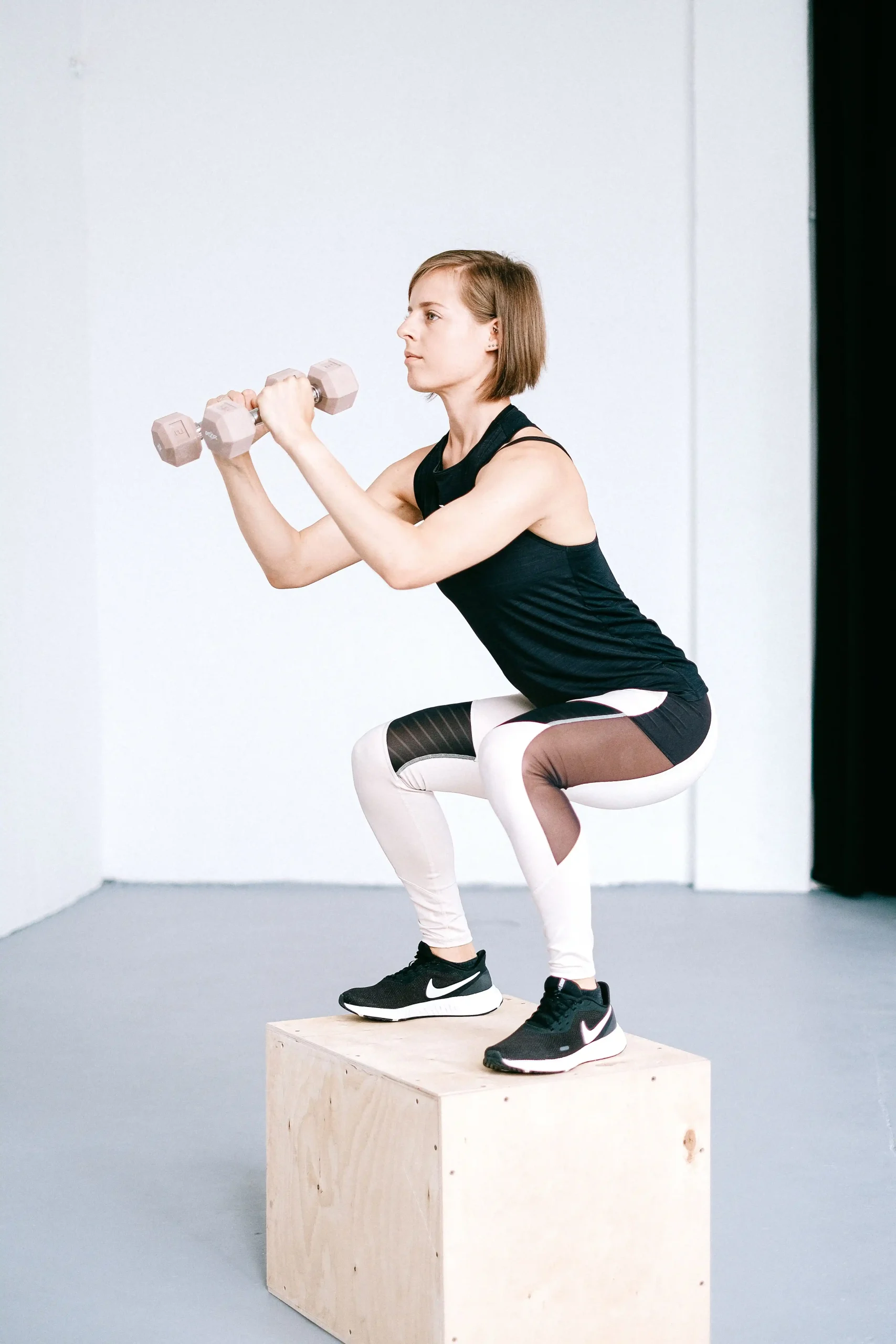
The goblet squat is an excellent beginner exercise for learning the basic squat movement while holding a dumbbell in front of your body. It primarily trains the lower body, including the quadriceps and glutes, while your core works to help stabilize your torso.
Stand with your feet approximately shoulder-width apart. Hold one dumbbell vertically with both hands at chest height. Keep your chest lifted and your shoulders relaxed.
Brace your core and slowly bend your knees and hips as you lower your body toward the floor. Keep your weight balanced through your feet and allow your knees to move naturally in line with your toes.
Lower only as far as you can while maintaining control and a comfortable position. Then push through your feet and extend your hips and knees to return to standing.
Perform 8 to 10 controlled repetitions.
The most important part of the goblet squat is not how low you can go. Focus on maintaining control throughout the entire movement. If holding a dumbbell feels uncomfortable, practice the same movement without weight until you feel confident.
Exercise 2: Dumbbell Rows
Dumbbell rows target the muscles of your upper back while also involving your arms and core. They provide a useful balance to the pressing movement later in the workout.
Hold a dumbbell in each hand. Stand with your feet approximately hip-width apart. Bend your knees slightly and hinge forward from your hips while keeping your back in a comfortable, neutral position.
Allow the dumbbells to hang beneath your shoulders. Pull the dumbbells toward your ribs while keeping your elbows close to your body. Pause briefly at the top of the movement, then lower the weights slowly.
Perform 8 to 10 repetitions.
Avoid using momentum to lift the dumbbells. If you have to swing your torso or jerk the weights upward, they are probably too heavy. The goal is to make your back muscles do the work while keeping your movement controlled.
As your strength improves, you can gradually increase the resistance while maintaining the same controlled technique.
Exercise 3: Dumbbell Romanian Deadlifts
The Romanian deadlift is a useful exercise for learning the hip-hinge movement and strengthening the posterior chain, including the hamstrings and glutes.
Stand with your feet about hip-width apart and hold a dumbbell in each hand in front of your thighs. Keep a slight bend in your knees.
Push your hips backward while keeping the dumbbells close to your legs. Lower the weights toward your shins while maintaining a stable torso. You should feel tension developing through the back of your thighs.
Once you reach a comfortable range of motion, press your feet into the floor and drive your hips forward to return to standing.
Perform 8 to 10 repetitions.
The dumbbells do not need to reach the floor. Your range of motion depends on your flexibility and ability to maintain good positioning. Stop the descent when you can no longer keep the movement controlled.
A common beginner mistake is turning the Romanian deadlift into a squat. Instead of bending deeply at the knees, think about sending your hips backward. This helps you learn the difference between a squat and a hip hinge.
Exercise 4: Dumbbell Shoulder Press
The dumbbell shoulder press works the shoulders and triceps while requiring your core to stabilize your body.
Stand or sit with a dumbbell in each hand. Bring the dumbbells to approximately shoulder height with your palms facing forward or slightly inward.
Brace your core and press the dumbbells upward until your arms are extended comfortably overhead. Avoid locking your elbows aggressively. Slowly lower the dumbbells back toward your shoulders.
Perform 8 to 10 repetitions.
Keep your ribs from flaring excessively as you press. If you find yourself leaning backward to complete the movement, reduce the weight.
Beginners can also perform this exercise while seated if standing feels difficult. The important thing is to maintain control and avoid using momentum.
Exercise 5: Farmer Carries
The farmer carry may look simple, but it challenges several areas at once. It trains grip strength while requiring your core, shoulders, and legs to stabilize your body as you walk.
Hold a dumbbell in each hand with your arms hanging naturally at your sides. Stand tall with your shoulders relaxed and your chest comfortable.
Begin walking slowly while maintaining an upright posture. Keep your steps controlled and avoid leaning from side to side.
Continue for approximately 30 to 40 seconds. Rest, then repeat during your second round.
Choose a weight that feels challenging but allows you to maintain good posture. The farmer carry should not become a race. Slow, controlled steps are more useful than rushing across the room.
If you have limited space, walk back and forth across a short area or simply perform a controlled stationary hold for 20 to 30 seconds.
How to Structure the 25-Minute Routine
A simple schedule can make this workout easy to follow.
Spend the first five minutes warming up. Then begin the five-exercise circuit.
Perform 8 to 10 goblet squats, followed by 8 to 10 dumbbell rows, 8 to 10 Romanian deadlifts, and 8 to 10 shoulder presses. Finish the circuit with a 30- to 40-second farmer carry.
Rest for approximately 30 to 60 seconds between exercises and take a slightly longer break between rounds if necessary.
Complete two rounds.
If you are a complete beginner, start with one round and gradually work toward two. The goal is to finish the workout feeling challenged but not completely exhausted.
Use the remaining few minutes for a gentle cooldown. Walk slowly, take controlled breaths, and perform comfortable stretches for the major muscle groups you trained.
How Heavy Should Your Dumbbells Be?
There is no single dumbbell weight that is appropriate for every beginner. Your starting weight depends on your current strength, experience, body size, and the particular exercise.
For example, you may be able to use heavier dumbbells for goblet squats than for shoulder presses. That is completely normal.
Start with a weight that allows you to perform the full set with good technique. If your form breaks down before you finish the repetitions, reduce the weight. If you can complete every repetition easily and feel that you could continue for many more repetitions, the weight may be too light.
As you become stronger, gradually increase the resistance. ACSM guidance emphasizes individualizing resistance training and progressively adjusting the workload rather than following one rigid prescription for everyone.
How Often Should Beginners Do Dumbbell Workouts?
For beginners, consistency is more important than trying to train every day. A full-body dumbbell workout can be performed as part of a weekly routine that gives your muscles time to recover between strength sessions.
Current ACSM guidance recommends resistance training for the major muscle groups at least twice per week for healthy adults, while also emphasizing that the program should be individualized according to goals, schedule, and ability.
You can combine this workout with walking, cycling, jogging, mobility work, or other activities on different days. If you are new to exercise, gradually increase your activity rather than suddenly adding several intense workouts at once.
Common Beginner Mistakes to Avoid
One of the most common mistakes is choosing dumbbells that are too heavy. Heavy weights do not automatically produce a better workout. If you cannot control the movement, the exercise becomes less effective and your technique can suffer.
Another mistake is rushing through repetitions. Strength training should be controlled. Take your time during both the lifting and lowering portions of each movement.
Skipping the warm-up is another habit worth avoiding. A short warm-up gives you an opportunity to practice the movements without heavy resistance and prepare mentally for the workout.
Finally, do not compare your starting point with someone else’s. A beginner workout should be about building your own strength and consistency. Progress may mean adding a small amount of weight, completing an additional repetition, improving your technique, or simply completing the workout more comfortably than you did the previous week.
A Simple Way to Progress
Once you can comfortably complete two rounds of the workout, you can begin making small adjustments.
You might add one or two repetitions to each exercise, increase the dumbbell weight slightly, extend the farmer carry by a few seconds, or reduce your rest time modestly.
You do not need to make every change at once. Pick one area to improve and give yourself time to adapt.
Keeping a simple workout log can also help. Write down the dumbbell weight you used, how many repetitions you completed, and how difficult the workout felt. Over several weeks, you can look back and see measurable progress.
Make Your Post-Workout Routine Enjoyable
Strength training is only one part of a healthy lifestyle. Nutrition, hydration, sleep, recovery, and regular movement all contribute to how you feel and perform.
If you enjoy a sweet snack after exercising, you can keep it simple by pairing protein-rich foods with flavors you enjoy. One option is Greek yogurt or cottage cheese topped with a small amount of a dessert seasoning.
For example, the Skinii Smokey-Sweet Dessert Topper is designed to be sprinkled over foods such as yogurt, oatmeal, cottage cheese, chia pudding, or other desserts. The product page lists 10 calories per teaspoon, 0 grams of added sugar, and 1 gram of dietary fiber per serving.
This kind of small addition can make a simple post-workout snack feel more satisfying without turning your routine into something complicated.

Beginner Dumbbell Workout Checklist
Before starting, prepare your dumbbells and clear enough space to move safely. Warm up for five minutes, then perform goblet squats, dumbbell rows, Romanian deadlifts, shoulder presses, and farmer carries.
Start with one round if you are new to resistance training. Work toward two rounds as your fitness improves. Keep the repetitions controlled, breathe throughout the movements, and choose a weight that allows you to maintain proper form.
Most importantly, remember that strength training is a long-term process. You do not need to master everything in your first workout. Learning the movements, showing up consistently, and gradually progressing can create a much stronger foundation than constantly chasing harder workouts.
Final Thoughts
A beginner dumbbell workout does not need to be complicated to be effective. This 25-minute full-body routine focuses on five foundational movements that can help beginners learn how to squat, hinge, pull, press, and carry resistance safely and confidently.
Goblet squats train the lower body, dumbbell rows strengthen the upper back, Romanian deadlifts develop the posterior chain, shoulder presses challenge the shoulders and arms, and farmer carries bring the workout together with a simple full-body stability and grip challenge.
Start with manageable weights, prioritize technique, and give yourself time to improve. As ACSM’s latest resistance-training guidance emphasizes, consistency and an individualized approach matter more than complicated training methods.
If you can dedicate just 25 minutes to strength training a couple of times each week and gradually build from there, you can turn a simple pair of dumbbells into a practical foundation for a stronger and more active lifestyle.


Leave a Comment