
The Beginner’s Circuit: A Fun, Fast, and Sustainable Full-Body Workout

Getting started with fitness can feel like standing at the base of a massive mountain. You look up at the complex gym machines, the ultra-fit people lifting heavy weights, and the hour-long classes, and it all feels overwhelming. Where do you even begin? This feeling of not knowing where to start—or starting a plan that’s too complicated, too time-consuming, or just plain boring—is why so many people quit before they ever see results.
What if there was a better way? A way to get a highly effective, full-body workout in just 30 minutes, using exercises that are easy to learn and don’t require a gym membership?
Enter circuit training. This workout style is the perfect antidote to beginner burnout. It’s an efficient, engaging, and incredibly powerful method for building strength, improving cardiovascular health, and creating a fitness habit that you can actually stick with [1]. This guide will break down everything you need to know and provide you with a complete, follow-along routine to start your journey today.
What Exactly is Circuit Training? (And Why Is It Perfect for Beginners?)
At its core, circuit training is a workout strategy where you move through a series of different exercises (a “circuit”) one after another, with very little rest in between. After you’ve completed one round of all the exercises in the circuit, you take a longer, scheduled rest. Then, you repeat the circuit for a set number of rounds.
This simple structure is a game-changer for beginners for several key reasons:
- It’s Time-Efficient: By minimizing rest between exercises, your heart rate stays elevated, allowing you to combine strength training and cardiovascular work into one short, powerful session. You can get a fantastic full-body workout in 30 minutes or less.
- It Beats Boredom: Instead of doing three sets of the same exercise before moving on, you’re constantly switching things up. Just as you start to get tired of one movement, it’s time to move to the next. This variety keeps your mind engaged and the workout feeling fresh and fun.
- It’s a Full-Body Solution: A well-designed circuit hits all your major muscle groups in a single session. This is ideal for beginners because it builds a strong, balanced foundation without needing to worry about complicated “split” routines (like “leg day” or “arm day”).
- It’s Infinitely Adaptable: Circuit training is a template, not a rigid set of rules. As you get stronger, you can easily modify the exercises, increase the work time, or add more rounds. It grows with you, ensuring you’re always challenged.
The Anatomy of Your Beginner’s Circuit (The Exercises)
A great circuit is balanced. This routine includes five fundamental movements that target your entire body, plus a cardio burst to keep your heart rate up. We will focus on bodyweight exercises, with one optional movement using light weights or a band for crucial back strength.
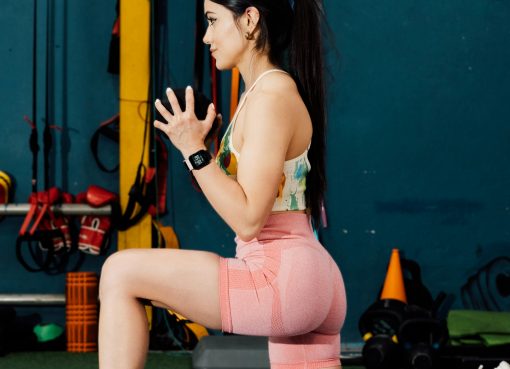
- 1. Bodyweight Squats (Target: Quads, Glutes, Hamstrings)
- This is the king of lower-body exercises. It mimics the real-life movement of sitting down and standing up.
- How to Do It: Stand with your feet shoulder-width apart, chest up, and core engaged. Push your hips back as if you’re about to sit in a chair, lowering until your thighs are parallel to the floor (or as low as you comfortably can). Keep your weight in your heels and your knees aligned with your toes. Press through your heels to return to the starting position.
- 2. Incline or Knee Push-ups (Target: Chest, Shoulders, Triceps)
- The push-up is the ultimate upper-body exercise. We’ll use a modification to make it accessible for beginners.
- How to Do It: For an incline push-up, place your hands on a sturdy, elevated surface like a countertop or the back of a sofa. For a knee push-up, start on the floor on your hands and knees. Your body should form a straight line from your head to your knees (or heels for incline). Lower your chest toward the surface, keeping your elbows at a 45-degree angle. Press back up to the start.
- 3. Glute Bridges (Target: Glutes, Hamstrings)
- This exercise activates your posterior chain—the muscles on the back of your body—which are essential for posture and power.
- How to Do It: Lie on your back with your knees bent, feet flat on the floor, and arms at your sides. Squeeze your glutes and lift your hips off the floor until your body forms a straight line from your shoulders to your knees. Pause at the top and slowly lower back down.
- 4. Plank (Target: Full Core)
- The plank is a masterclass in core stability, teaching your abs, back, and hips to work together to protect your spine.
- How to Do It: Prop yourself up on your forearms and toes, keeping your body in a perfectly straight line. Don’t let your hips sag or rise too high. Brace your core as if you’re about to be punched in the stomach.
- 5. Step-Jacks (Cardio Burst)
- This is your low-impact cardio move to get your heart rate up without the noisy jumping.
- How to Do It: Start standing with your feet together. Step your right foot out to the side while simultaneously raising both arms overhead. Return to the start and immediately repeat on the left side. Move at a brisk, continuous pace.
- 6. Bent-Over Rows (Target: Back, Biceps)
- Strengthening your back is crucial for good posture. This is the one exercise where a light object is highly recommended.
- How to Do It: You can use light dumbbells, water bottles, or a resistance band. Stand with feet shoulder-width apart, holding a weight in each hand. Hinge at your hips so your torso is at a 45-degree angle, keeping your back straight. Let the weights hang down. Squeeze your shoulder blades together and pull the weights up toward your chest, keeping your elbows close to your body. Slowly lower back down.
Your Full-Body Workout Plan: Let’s Get Moving!
Here is the exact plan. Set a timer and get ready to work! Total Time: Approx. 25-30 minutes.
- The 3-Minute Warm-Up (Don’t Skip This!)
- 30 seconds of marching in place
- 30 seconds of arm circles (forward and backward)
- 30 seconds of torso twists
- 30 seconds of leg swings (per side)
- 30 seconds of bodyweight squats (slow and controlled)
- The Beginner’s Circuit Perform each exercise for 45 seconds, followed by 15 seconds of rest to transition to the next exercise.
- Bodyweight Squats (Work: 45s, Rest: 15s)
- Incline or Knee Push-ups (Work: 45s, Rest: 15s)
- Glute Bridges (Work: 45s, Rest: 15s)
- Plank (Work: 45s, Rest: 15s)
- Step-Jacks (Work: 45s, Rest: 15s)
- Bent-Over Rows (Work: 45s)
- After completing the Bent-Over Rows, take a 90-second rest. This completes one full round. Your Goal: Complete 3 full rounds.
- The 3-Minute Cool-Down (Just as Important!)
- 30 seconds quad stretch (per side)
- 30 seconds hamstring stretch (per side)
- 30 seconds chest stretch (in a doorway)
- 30 seconds glute stretch (figure-four)
Making It Sustainable: How to Progress and Stay Motivated
A workout is only good if you stick with it. Here’s how to make this circuit a long-term habit.
- How to Progress: Once 3 rounds of the circuit start to feel manageable, you can make it more challenging in several ways (choose only one at a time):
- Increase Work Time: Move to 50 seconds of work and 10 seconds of rest.
- Add a Round: Progress from 3 rounds to 4.
- Advance the Exercises: Move from knee push-ups to full push-ups, or add a dumbbell to your squats (goblet squat).
- Reduce Main Rest: Shorten your rest between rounds from 90 seconds to 60 seconds.
- How to Stay Consistent:
- Start Small: Commit to just two sessions per week on non-consecutive days (e.g., Monday and Thursday). This is achievable and allows for proper recovery.
- Schedule It: Treat your workouts like important appointments. Block them off in your calendar.
- Focus on the Feeling: Pay attention to how you feel after the workout—more energized, accomplished, less stressed. This positive reinforcement is more powerful than focusing only on physical changes.
Frequently Asked Questions (FAQ)
- How many days a week should I do this circuit? For a true beginner, starting with 2 days a week is perfect. Once you feel comfortable and are recovering well, you can increase to 3 days a week, always ensuring there’s a rest day in between (e.g., Mon/Weds/Fri).
- What if I can’t do an exercise for the full 45 seconds? That is completely normal! Simply do as many good-quality reps as you can, then stop and rest for the remainder of the 45-second interval. Next time, try to get one or two more seconds of work in. It’s about personal progress, not perfection.
- Do I absolutely need equipment to start? You can start this circuit with just your body weight. For the Bent-Over Row (exercise #6), you can substitute it with “Supermans” (lying on your stomach and lifting your arms and legs) to work your back. However, investing in a simple resistance band is a cheap and highly effective way to properly train your back muscles.
- When will I start seeing results? You will start feeling results—like more energy and better sleep—within the first one or two weeks. Visible physical changes, like muscle definition and weight loss (if paired with a healthy diet), typically take more time, often 4-8 weeks of consistent effort. Be patient and trust the process [2]. A key part of muscle maintenance and recovery is protein, so a supplement like Skinii.com’s Vegan Protein Low Carb Vanilla can be an excellent addition to your routine [3].
Conclusion: Your Fitness Journey Starts Now
Fitness doesn’t have to be a complex, time-draining chore. With a simple, well-designed circuit, you have the power to transform your health in just 30 minutes a day, a few times a week. This routine is more than just a workout; it’s a starting point, a confidence-builder, and a sustainable foundation for a lifetime of movement. A healthy diet, including supplements, can also provide you with the nutrients you need to achieve your goals. For example, Skinii.com’s Biotin can help support the health of your hair, skin, and nails, which often see improvements as you adopt a healthier lifestyle [4].
Forget the overwhelming gym and the workouts that leave you feeling defeated. You have a plan. You have the exercises. Your fitness journey starts right here, right now. Give it a try—you’re stronger than you think.
Works Cited
- American College of Sports Medicine. (n.d.). Circuit Training: A Brief Guide. https://www.acsm.org/docs/default-source/files-for-resource-library/circuit-training.pdf
- American Council on Exercise. (n.d.). How Long Does It Take to See Results From Exercise?. https://www.acefitness.org/resources/pros/expert-articles/6005/how-long-does-it-take-to-see-results-from-exercise/
- National Center for Biotechnology Information. (2019). Protein and Exercise: A Primer. https://www.ncbi.nlm.nih.gov/pmc/articles/PMC6827057/
- Cleveland Clinic. (2023). Biotin. https://my.clevelandclinic.org/health/articles/24467-biotin


Leave a Comment