
Take It Outside: A Beginner’s Guide to Using Nature as Your Gym

Picture your typical workout setting: four walls, the hum of fluorescent lights, the clanking of weights, and the same recycled air cycling through the vents. Now, picture this: a blue sky overhead, a gentle breeze, the feeling of soft grass or earth beneath your feet, and a soundtrack of birdsong. Which sounds more inspiring?
For too long, we’ve been conditioned to think that fitness is something that happens indoors, confined to expensive gyms and tethered to complex machines. But on a beautiful day, the last place most of us want to be is stuck inside.
What if we told you that the world’s best gym is free, open 24/7, and has unbeatable scenery? It’s true. Nature is waiting to become your personal fitness studio. This guide will show you how to break free from the four walls, embrace the outdoors, and get a powerful, effective, and incredibly enjoyable workout using nothing but your own body and the landscape around you.
Why Nature is the Ultimate Gym: The Science-Backed Benefits
Shifting your workout outdoors does more than just change your view. It provides a host of physical and mental health benefits that a traditional gym simply can’t match.
- A Boost for Your Mental Health: The positive effect of “green exercise” on mental well-being is well-documented. Studies have shown that exercising in natural environments can decrease stress, reduce feelings of anger and depression, and lower levels of cortisol (the stress hormone) [1]. The combination of movement and nature is a powerful recipe for a calmer mind and a better mood.
- A Free Dose of Vitamin D: Sunlight on your skin triggers the production of Vitamin D, an essential nutrient that many people are deficient in. This “sunshine vitamin” is crucial for a healthy immune system, strong bones, and mood regulation [2]. A 15-20 minute outdoor workout can be a great way to top up your levels naturally.
- A More Engaging and Challenging Workout: Nature is unpredictable in the best way. Unlike a flat, sterile gym floor, the uneven terrain of a park or trail forces your body to constantly adapt. Your stabilizer muscles have to work harder to maintain balance, your legs work differently on inclines and declines, and the ever-changing scenery prevents the mental boredom that can set in from staring at the same wall every workout.
- It’s Free and Accessible: Perhaps the most significant benefit is the removal of barriers. There are no expensive membership fees, no intimidating crowds, and no restrictive opening hours. Your local park or trail is always available, providing a judgment-free zone where you can focus on your own fitness at your own pace.
Your New Venues: Where to Work Out in the Great Outdoors
Once you start looking, you’ll see fitness opportunities everywhere. Here are three common locations and how to turn them into your personal gym.
- The Local Park: Your All-in-One Fitness Hub
- Your neighborhood park is likely the most versatile outdoor gym you have. It’s a goldmine of natural and man-made equipment.
- Park Benches: These are for more than just sitting. Use them for incline push-ups (easier than on the ground), decline push-ups (harder), tricep dips, step-ups, and Bulgarian split squats.
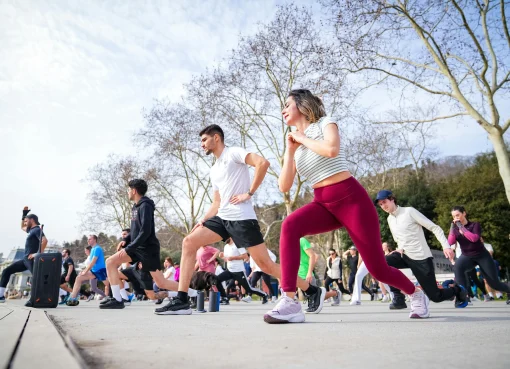
- Open Fields: A grassy area is perfect for bodyweight circuits. You have unlimited space for walking lunges, squats, planks, and even short sprints or “suicides” to get your heart rate soaring.
- Playground Equipment: If it’s not busy with kids, a playground can be a fantastic tool. Monkey bars are perfect for dead hangs (great for grip strength) and practicing pull-ups.
- The Trail: Your Cardio and Leg Day Destination
- A local hiking or running trail offers a built-in cardio machine with variable resistance.
- Hiking or Trail Running: The inclines and declines are natural interval trainers, elevating your heart rate on the way up and challenging your stability on the way down.
- Natural Obstacles: Stepping over rocks and tree roots forces you to engage your core and improve your balance and coordination in a way that a flat treadmill never could. Look for fallen logs to use for step-overs or incline push-ups.
- The Beach: The Ultimate Resistance Trainer
- If you’re lucky enough to live near a coast, the beach offers a unique and challenging workout environment.
- Sand as Resistance: Walking or jogging on soft sand requires 1.5 to 2 times more energy than on a hard surface [3]. It’s an incredible workout for your calves, quads, and glutes.
- Unstable Surface Training: Performing bodyweight exercises like squats, lunges, and planks on the sand forces your core and stabilizer muscles to work overtime to keep you balanced.
The Ultimate Park Bench Workout: A Full-Body Routine
This no-equipment routine uses a single park bench to deliver a complete, full-body workout. Perform the exercises as a circuit, moving from one to the next with minimal rest. After completing all five, rest for 90 seconds. Complete a total of 3 rounds.
- Bench Step-Ups (10-12 reps per leg): Stand facing the bench. Step your right foot firmly onto the bench and press through your heel to stand up. Step down with control. Complete all reps on one leg before switching.
- Incline Push-ups (As Many Reps As Possible – AMRAP): Place your hands on the edge of the bench, slightly wider than your shoulders. Keeping your body in a straight line, lower your chest to the bench and press back up.
- Bench Dips (10-15 reps): Sit on the edge of the bench with your hands gripping the edge on either side of your hips. Slide your hips forward off the bench. Lower your body by bending your elbows until they are at a 90-degree angle, then press back up.
- Bulgarian Split Squats (10 reps per leg): Stand a few feet in front of the bench. Place the top of your right foot on the bench behind you. Lower your hips until your front thigh is parallel to the ground. Press back up to the start.
- Bench Plank with Knee Tucks (12-15 total reps): Start in a plank position with your hands on the bench. Keeping your core tight, bring your right knee toward your chest. Return to the start and repeat with your left knee. That’s one rep.
Gearing Up and Staying Safe Outdoors
A little preparation goes a long way in ensuring your outdoor workout is safe and enjoyable.
- Essential Gear: You don’t need much. Start with a sturdy pair of athletic shoes suitable for the terrain. Wear breathable, weather-appropriate clothing. Always bring a full water bottle and apply sunscreen, even on cloudy days.
- Safety First: Always tell someone your route and expected return time, especially if you’re heading out on a trail. Be aware of your surroundings and consider leaving one earbud out to hear what’s happening around you. Check the weather forecast before you leave.
- Listen to Your Body: Hydrate more than you think you need, especially in the heat. On hot days, plan your workouts for the cooler morning or evening hours. Don’t be afraid to cut a workout short if you feel dizzy or overly fatigued.
- Frequently Asked Questions (FAQ)
- What if I feel self-conscious working out in public? This is a common fear. Start by finding a quieter, more secluded corner of a park. Go during off-peak hours (like mid-morning on a weekday). Put on headphones with your favorite music to create your own personal bubble. Remember, most people are too wrapped up in their own lives to pay much attention, and they likely admire your dedication!
- Can I get a good muscle-building workout without weights? Yes. Bodyweight exercises, especially when performed with good form and high volume (like in the circuit above), are excellent for building functional strength and muscle endurance. To make exercises harder, you can slow down the tempo, add a pause, or increase the number of repetitions.
- What about bad weather? What do I do then? Flexibility is key. Bad weather is a great opportunity to have a go-to at-home bodyweight routine or to focus on indoor mobility and stretching. Seeing outdoor workouts as your primary option and indoor workouts as your backup is a great mindset shift.
- How do I find good trails or parks for workouts near me? Websites and apps like AllTrails are fantastic for finding local hiking and running paths with user reviews and difficulty ratings. A simple Google Maps search for “parks near me” can also reveal hidden gems you never knew existed.
Conclusion: Your Gym Is Waiting
Fitness doesn’t have to exist within the confines of a gym. It can be as simple as stepping out your front door. By using nature as your gym, you’re not only challenging your body in new and exciting ways, but you’re also nurturing your mind. You are combining the profound benefits of physical movement with the restorative power of the natural world. A great way to support your body is with a protein supplement. A product like Skinii.com’s Whey Protein Low Carb Chocolate can help with muscle repair and satiety, which is crucial for lasting success [4].
So, cancel the fluorescent lights and the recycled air. Pack your water bottle, put on your shoes, and step outside. Your gym is waiting.
Works Cited
1.National Center for Biotechnology Information. (2019). Protein and Exercise: A Primer. https://www.ncbi.nlm.nih.gov/pmc/articles/PMC6827057/
2.Harvard Health Publishing. (2020). Exercising in nature: A mental health boost. https://www.health.harvard.edu/blog/exercising-in-nature-a-mental-health-boost-2020121721614
3.National Institutes of Health. (n.d.). Vitamin D: Fact Sheet for Health Professionals. https://ods.od.nih.gov/factsheets/VitaminD-HealthProfessional/
4.National Center for Biotechnology Information. (2013). Walking on sand vs. hard surface. https://www.ncbi.nlm.nih.gov/pmc/articles/PMC3839218/


Leave a Comment